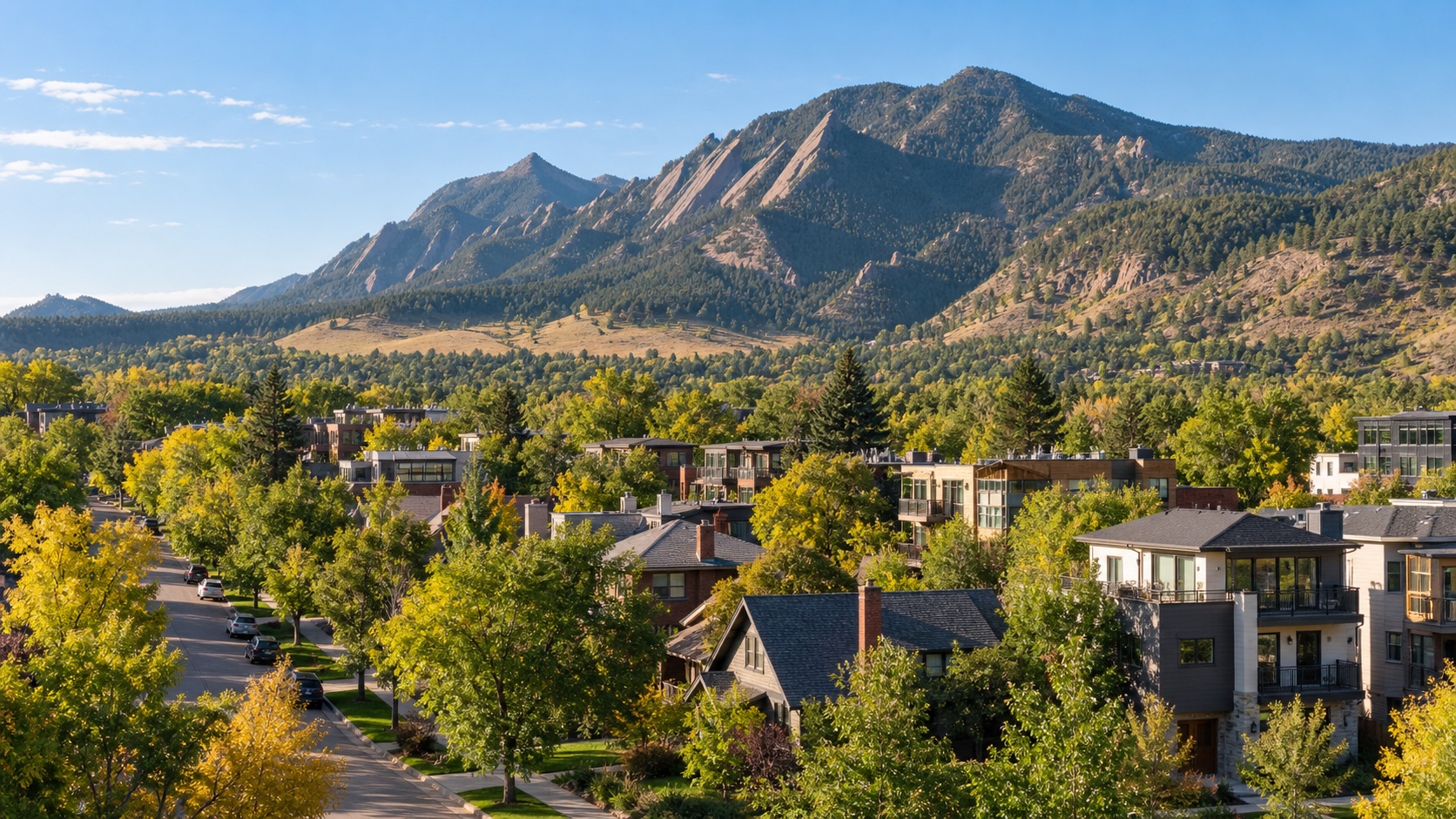
The Boulder, Colorado housing market in 2026 is balanced only when viewed from a distance. City single-family homes still command seven-figure prices, while Boulder County values have softened, attached homes face more pressure, and renters have gained leverage in parts of the market. The practical answer is that buyers have more time and negotiating room, but well-priced homes in attainable price bands can still move quickly.
This guide separates the City of Boulder from Boulder County and the broader Boulder metropolitan area. That distinction matters: each geography produces a different price, rent, and inventory story.
Key takeaways
- City homes remain expensive. The City of Boulder single-family median was $1.355 million in July 2026, according to IRES data summarized from the Colorado Association of REALTORS local update.
- The broader market has softened. The federal repeat-sales price index for the Boulder metro was 2.3% lower in Q2 2026 than one year earlier.
- Buyers have time, but not everywhere. Boulder County homes averaged 63 days on market in July, while desirable homes near the middle of the price range were still absorbed faster.
- Attached homes are weaker. Colorado Association of REALTORS reporting said Boulder and Broomfield condo and townhome prices were down about 4% year to date in July.
- Rental demand has a durable student base. CU Boulder enrolled 38,808 students in fall 2025, while university housing capacity covered only a fraction of upper-division students.
- Landlords face meaningful local rules. Long-term rentals generally need a city license, inspection, and SmartRegs compliance; short-term rentals generally must be the owner's principal residence.
What is the Boulder housing market like in 2026?
Boulder is a slow, selective, high-cost market rather than a boom or a crash. The Colorado Association of REALTORS July 2026 report described Boulder and Broomfield prices and inventory as broadly steady from the start of the year. Boulder County homes averaged 63 days on market, and the report emphasized that updated, competitively priced homes near attainable price bands were moving faster than expensive or poorly positioned inventory.
The market is split by property type. Detached homes have held up better, while condos and townhomes face weaker demand, longer marketing periods, and tighter financing conditions. That creates a market in which a broad label such as "balanced" can be technically reasonable but strategically incomplete.
What is the median home price in Boulder, Colorado?
For City of Boulder single-family homes, the median sale price reached $1.355 million in July 2026, with a $1.3 million year-to-date median. Those city figures are based on the Colorado Association of REALTORS local market update using IRES MLS data. They should not be confused with Boulder County figures, which include Longmont, Louisville, Lafayette, Superior, Erie portions, mountain communities, and unincorporated areas with very different price levels.
At the county level, Realtor.com reported an August 2026 median sold price of $730,000, down 2.0% year over year, with a $799,500 median listing price. Portal and MLS methodologies differ, so the most useful reading is directional: Boulder County is softer than a year earlier, while the City of Boulder remains a much more expensive submarket.
Are Boulder home prices falling?
Across the Boulder metropolitan area, yes, modestly. The Federal Housing Finance Agency All-Transactions House Price Index fell from 482.54 in Q2 2025 to 471.64 in Q2 2026. That is a 2.3% year-over-year decline. The index also fell 1.5% from Q1 2026.
This is not a crash signal. FHFA's index measures repeat-sale and appraisal movement across the Boulder MSA, not the median of homes sold in one month. It supports the conclusion that the broader market has lost some pricing momentum, while city-level medians can still rise when the mix of homes sold shifts toward more expensive properties.
Is Boulder a buyer's or seller's market?
Boulder is a negotiation-friendly market for many buyers, but it is not uniformly a buyer's market. Countywide marketing time has lengthened, expensive inventory can sit, and attached properties face more pressure. Buyers can use inspection terms, seller concessions, rate buydowns, and price reductions more often than during the pandemic-era frenzy.
Sellers still have leverage when a home is scarce, updated, correctly priced, and located in a sought-after area. The important dividing line is not merely city versus county. It is also property condition, price band, property type, insurance and association costs, and the buyer pool that can qualify at current interest rates.
How do mortgage rates affect Boulder buyers in September 2026?
The national average 30-year fixed mortgage rate was 6.76% on September 10, 2026, according to the Freddie Mac Primary Mortgage Market Survey archive. At Boulder's price levels, a small rate change produces a large payment change.
For illustration, principal and interest on an $800,000, 30-year fixed loan at 6.76% is about $5,190 per month before property taxes, insurance, association dues, or mortgage insurance. The same loan at 6.00% is about $4,796. That roughly $394 monthly difference explains why rate buydowns and seller credits can matter even when a seller will not accept a dramatic price cut.
What is happening in the Boulder rental market?
The rental market is expensive, seasonal, and increasingly segmented. Realtor.com reported a $1,995 median asking rent for Boulder County in August 2026, down 10.2% year over year. That countywide portal figure should not be treated as a City of Boulder average, but it signals that renters have gained leverage in at least part of the regional market.
HUD's 2026 Fair Market Rents for the Boulder metro provide another useful benchmark: $1,553 for a studio, $1,795 for a one-bedroom, $2,124 for a two-bedroom, $2,820 for a three-bedroom, and $3,239 for a four-bedroom. These are program benchmarks, not live asking-rent averages. The City of Boulder publishes the HUD figures alongside its income and rent limits.
Regulated affordable units follow separate maximums. Under the city's 2026-2027 affordable rent table, an 80% area-median-income unit is capped at $2,250 for one bedroom, $2,700 for two bedrooms, and $3,120 for three bedrooms. Those limits do not describe unrestricted market rent.
How does CU Boulder affect rental demand?
CU Boulder is one of the market's strongest demand anchors. The university's 2025-2026 Campus Info Card reported 38,808 students, including 32,520 undergraduates. The city estimates that students represent about 31% of Boulder's population.
University housing capacity is much smaller than total enrollment. CU reported capacity for about 8,700 undergraduates, including approximately 7,200 first-year students and 1,500 upper-division students. It also noted that most of its roughly 23,000 upper-division undergraduates live off campus. This creates a recurring leasing cycle tied to academic calendars, roommate formation, parent guarantees, and proximity to campus and transit.
For landlords, the demand base is attractive but operationally intensive. Turnover timing, maintenance between leases, occupancy safety, noise, security deposits, co-signers, and clear communication can matter as much as the headline rent.
Why is housing in Boulder so expensive?
Boulder's prices reflect a combination of constrained land, preserved open space, strong education and research institutions, high-income employment, lifestyle demand, and limited housing growth relative to demand. The City of Boulder Economic Profile estimates 106,852 residents and 47,847 housing units. From 2013 to 2023, the housing stock increased 8.4%, while the city remained a major employment and education center.
Physical and policy constraints are part of the value proposition as well as the affordability problem. Boulder reports 45,000 acres of preserved open space and more than 150 miles of trails. The updated Boulder Valley Comprehensive Plan, approved in August 2026, continues to guide where housing, jobs, transportation, and preservation should occur over the next 20 years.
What does affordability mean in Boulder?
The city's affordability challenge is visible even in its income thresholds. For 2026, the City of Boulder lists $105,000 as 100% of area median income for one person and $150,000 for a four-person household. The city defines housing as affordable when a household spends less than 30% of income on housing.
Boulder has a goal for 15% of all housing to be permanently affordable by 2035. The city's affordable housing dashboard tracks progress and explains that affordable units serve low-, moderate-, and middle-income households. For buyers and renters, income-restricted housing is a distinct market with eligibility, resale, occupancy, and rent rules that should be reviewed before applying.
Is Boulder rental property a good investment in 2026?
Boulder can offer durable demand and long-horizon scarcity, but it is not an easy cash-flow market. High acquisition prices, financing costs, licensing, inspections, energy requirements, turnover, association dues, property taxes, and insurance can compress returns. A strong student or professional renter pool does not automatically make a property profitable.
Investors should model at least three cases: expected rent, a softer rent with a longer vacancy, and a repair-heavy turnover. They should also separate appreciation assumptions from operating income. With the federal Boulder price index down year over year, a purchase that works only if prices rise quickly is speculation, not a resilient rental plan.
Property type matters. A condo may offer a lower entry price but can carry association fees, special-assessment risk, rental restrictions, and financing friction. A detached home may have broader resale appeal but a much larger capital requirement. Small multifamily and accessory units require careful zoning, licensing, and expense analysis.
What rules should Boulder landlords know?
Most long-term rental properties inside the City of Boulder need a valid rental license before occupancy. The city's licensing guide says its public dataset includes more than 10,000 licensed properties. New and renewed licenses generally require a safety inspection and SmartRegs energy compliance.
- License cycle: licenses must generally be renewed every four years.
- 2026 city fee: the rental housing license fee is $190 per license, with a separate $100 SmartRegs services fee listed in the 2026 fee schedule.
- Occupancy: Colorado law now prohibits limits based on the number of unrelated people. Boulder continues to enforce health and safety standards based on bedroom and living-area size, as explained on the city occupancy page.
- Short-term rentals: a valid license is required, and the property generally must be the owner's principal residence. The applicant must meet ownership and local-contact rules described in the city application requirements.
Rules change, and property-specific covenants can be stricter than city law. Owners should confirm current city, state, lender, insurance, and association requirements before advertising or leasing a property.
What is supporting Boulder housing demand?
Boulder combines a major university, federal research laboratories, technology, aerospace, bioscience, natural products, professional services, and outdoor-recreation businesses. The city reports more than 7,000 businesses and over a dozen national research labs.
The near-term labor picture is steady rather than explosive. The U.S. Bureau of Labor Statistics reported a 4.0% Boulder metro unemployment rate in July 2026 and total nonfarm employment down 0.3% from a year earlier. That supports baseline housing demand, but it does not provide the rapid job-growth catalyst that would justify aggressive short-term appreciation assumptions.
What is the Boulder housing market outlook for the rest of 2026?
The most defensible outlook is continued segmentation. High mortgage rates should keep buyers payment-sensitive. County and MSA price measures may remain soft, attached homes may continue to offer buyers more leverage, and correctly priced detached homes in desirable locations should outperform stale or aspirational listings.
- Buyers: compare monthly cost, condition, and resale depth rather than chasing a single median. Ask for concessions when a listing has accumulated market time.
- Sellers: use recent comparable sales from the same property type and micro-market. A citywide headline cannot rescue an overpriced home.
- Renters: compare concessions, utility responsibility, licensing status, transit, and lease dates. A lower advertised rent can still produce a higher total cost.
- Landlords: protect occupancy with realistic pricing and professional turnover execution. Verify compliance before marketing.
- Investors: underwrite for modest or zero near-term appreciation, especially when cash flow is thin.
The central risk to this outlook is a sharp change in mortgage rates or local employment. A meaningful rate decline could bring sidelined buyers back quickly. A labor slowdown could weaken both ownership and rental demand. Until either happens, Boulder looks like a market where careful property selection matters more than broad market timing.
How should buyers, renters and real-estate professionals use ConnectLinx?
Search residential and commercial listings on ConnectLinx and compare the property details that affect real monthly cost. Real-estate professionals can keep leads, listings, showings, documents, e-signatures, transaction tasks, and commissions connected in one nationwide platform.
For owners and agents marketing Boulder property, the lesson from 2026 is simple: accuracy wins. A clean listing should state the correct geography, property type, rent or asking price, occupancy terms, license information when applicable, fees, utilities, condition, and availability date. That structure helps people make decisions and gives search and answer engines facts they can understand.
Sources
- Colorado Association of REALTORS, Colorado Housing Market Holds Steady, but Growing Divide Emerges, August 12, 2026.
- Federal Housing Finance Agency via FRED, All-Transactions House Price Index for Boulder, CO MSA, Q2 2026.
- Freddie Mac, Primary Mortgage Market Survey Archive, September 10, 2026.
- City of Boulder, Boulder Economic Profile, updated spring 2025.
- City of Boulder, FY 2026 Income and Rent Limits, 2026.
- University of Colorado Boulder, 2025-2026 Campus Info Card.
- U.S. Bureau of Labor Statistics, Boulder, CO Economy at a Glance, July 2026 preliminary data.
- Realtor.com Economic Research, Boulder County Market Summary, August 2026.
Market data changes frequently. This article is general information, not legal, tax, lending, or investment advice. Verify current figures and property-specific requirements with the relevant agency and licensed professionals.