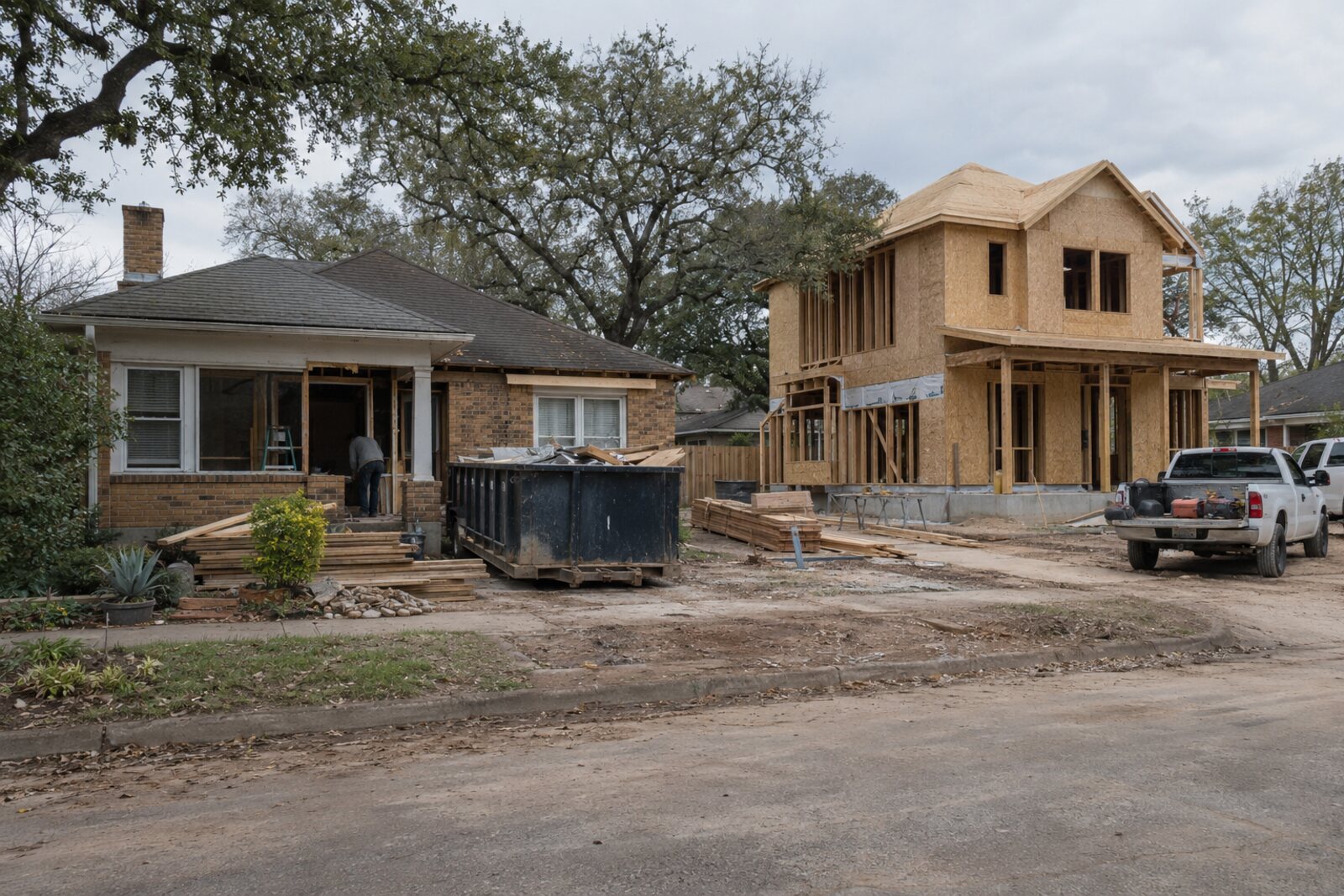
ConnectLinx helps Texas real estate professionals keep listings, contacts, documents, e-signatures, and transaction details organized whether a client chooses a ground-up build or the rehabilitation of an existing property. The two strategies can produce similar finished homes, but the path, risk, timeline, financing, and due diligence are fundamentally different.
Texas is a useful market for this comparison because it combines a large real estate workforce with substantial construction activity and wide geographic variation. The Texas Real Estate Commission reported 141,617 active sales agents in June 2025, alongside 32,941 active individual brokers and 14,623 active business-entity brokers. Source: Texas Real Estate Commission. Conditions also differ sharply between infill neighborhoods in Houston, Dallas, Austin, and San Antonio; suburban growth corridors; rural counties; and windstorm-designated Gulf Coast areas.
Quick answer: Is it better to build new or rehab in Texas?
Ground-up construction is usually the better fit when the land, location, financing, and exit value support a purpose-built property and the owner can tolerate a longer preconstruction process. Rehabilitation is often the better fit when an existing structure has sound fundamentals, a desirable location, reusable systems or materials, and a renovation scope that can be defined before closing.
Neither option is automatically cheaper. A low acquisition price can hide foundation, drainage, electrical, plumbing, roof, asbestos, lead, or permitting problems. A vacant lot can hide utility-extension costs, restrictive covenants, easements, floodplain issues, impact fees, soil conditions, and a finished value that does not justify construction.
Ground-up construction vs. rehabilitation at a glance
| Decision factor | Ground-up construction | Existing-property rehab |
|---|---|---|
| Design flexibility | Highest, within zoning, deed, budget, and engineering limits | Constrained by the existing footprint and structure |
| Unknown conditions | Mostly land, soil, utilities, approvals, and pricing risk | Mostly hidden building conditions and code-trigger risk |
| Early timeline | Longer due to design, engineering, financing, and permits | Can start faster if inspections and scope are complete |
| Change-order risk | Design changes and material selections | Hidden damage and discoveries after demolition |
| Energy and systems | New envelope, equipment, wiring, plumbing, and warranties | Mix of new and retained components |
| Neighborhood fit | Must support the finished size, design, and price | Existing scale may align more naturally with nearby sales |
| Holding-cost exposure | Often longer before occupancy or sale | Potentially shorter, but severe surprises can erase the advantage |
When ground-up construction makes sense
A new build can be attractive when the buyer controls a suitable lot and local comparable sales support the completed project. Starting from a blank site allows the team to optimize room layout, accessibility, energy performance, mechanical systems, parking, drainage, and technology infrastructure instead of working around old conditions.
It may also reduce near-term maintenance after completion because the roof, structure, electrical, plumbing, HVAC, and finishes are new. That does not mean the project is low risk. New construction moves more risk into the entitlement, design, site-work, contractor, supply, draw, inspection, and absorption phases.
Ground-up due-diligence questions
- Does zoning allow the intended use, density, setbacks, height, parking, and lot coverage?
- Do deed restrictions or an owners association impose additional limits?
- Are water, sewer, power, gas, drainage, and internet available at the property line?
- Is the site inside a mapped flood hazard area or subject to local drainage requirements?
- What do the survey, title commitment, easements, and access rights show?
- Does the soil or topography require unusual foundation, retaining, or grading work?
- Who owns the plans, and are architectural and engineering services complete?
- Are the contractor's allowances realistic for the intended finish level?
- What comparable completed homes support the projected value?
When rehabilitating an existing property makes sense
A rehab may be attractive when the building has a durable structure, a useful footprint, established utility connections, and a location where replacement land is scarce. Existing trees, neighborhood character, a mature street network, and a smaller environmental footprint can also carry value that is difficult to reproduce with a new build.
The central risk is uncertainty behind the walls and below the slab. A cosmetic budget is unreliable until qualified professionals evaluate the foundation, drainage, roof, envelope, electrical service, plumbing and sewer lines, HVAC, moisture, pests, and any hazardous-material concerns. Investors should distinguish a cosmetic renovation from a substantial rehabilitation before underwriting the deal.
Rehab due-diligence questions
- Which components are being retained, repaired, or fully replaced?
- Were previous additions permitted and constructed correctly?
- Will the proposed work trigger current-code upgrades elsewhere in the building?
- Are there foundation movement, drainage, moisture, termite, or roof problems?
- Has the electrical panel, wiring, supply plumbing, and sewer line been scoped?
- Could lead-based paint, asbestos-containing materials, or mold affect the work plan?
- Can the existing layout meet the target buyer's needs without expensive structural changes?
- Does the budget include demolition discoveries and a realistic contingency?
Texas permits and location-specific rules
Texas does not operate as one uniform construction market. Municipalities and counties can have different permit processes, adopted codes, inspection capacity, zoning rules, and development requirements. A project in central Austin should not be underwritten with assumptions from suburban Dallas-Fort Worth, rural Central Texas, or coastal Galveston County.
Coastal projects require special attention. The Texas Department of Insurance states that structures in designated catastrophe areas that are constructed, repaired, altered, or enlarged on or after April 1, 2026 must comply with the applicable 2024 International Residential Code or International Building Code standards to qualify for windstorm and hail insurance through the state program. Confirm the project's location, inspection path, and documentation before work begins. Source: Texas Department of Insurance.
National construction data also provides context rather than a property-level forecast. The U.S. Census Bureau reported that permits authorized approximately 1.43 million privately owned housing units nationwide during 2025. Its Building Permits Survey offers state, metro, county, and place-level data, which is more useful when an agent or developer narrows the analysis to a specific Texas market. Source: U.S. Census Bureau Building Permits Survey.
Texas tax treatment can differ
Construction budgets should be reviewed with a qualified Texas tax professional because contract structure and property type can affect sales-tax treatment. The Texas Comptroller explains that labor to repair, remodel, or restore residential real property is generally not taxable, while the treatment of materials differs between lump-sum and separated contracts. Nonresidential repair and remodeling is treated differently, and the total charge may be taxable. Source: Texas Comptroller.
The Comptroller also provides separate guidance for homebuilders and real-property services connected with new residential construction. Agents should avoid estimating tax consequences for clients and instead flag the issue early for the contractor, accountant, and attorney. Source: Texas Comptroller.
How to compare the budgets correctly
Do not compare only the rehab purchase price with the new-build construction contract. Compare complete project cost through a common endpoint.
Ground-up total-cost framework
- Land acquisition and closing costs
- Survey, title, environmental, soil, and feasibility work
- Architecture, engineering, permits, and utility fees
- Demolition or clearing, grading, drainage, foundation, and vertical construction
- Financing fees, draw costs, interest, insurance, and taxes during construction
- Landscaping, driveways, fences, appliances, and items excluded from allowances
- Contingency, marketing, commissions, and disposition costs
Rehab total-cost framework
- Property acquisition and closing costs
- Inspections, scopes, plans, engineering, testing, and permits
- Demolition, remediation, structural repairs, and all renovation trades
- Temporary utilities, security, debris removal, and site protection
- Financing, interest, insurance, taxes, and relocation or vacancy costs
- Contingency for concealed conditions
- Marketing, commissions, and disposition costs
Use the same assumptions for financing duration, sale costs, leasing period, and required return. A rehab that appears cheaper can become more expensive if it requires repeated scope revisions and carries an extra six months. A new build can lose its advantage if site work and utility extensions were omitted from the initial estimate.
How agents can guide the decision
Texas real estate agents should define their role carefully. Agents can organize comparable sales, property history, listing information, market positioning, transaction deadlines, and referrals to qualified inspectors, contractors, engineers, surveyors, lenders, attorneys, insurance professionals, and tax advisers. They should not present engineering, legal, tax, or construction opinions as professional conclusions.
For resale analysis, build two comparable sets: renovated existing homes and recently completed new construction. Study price per square foot, lot value, days on market, seller concessions, finish level, functional layout, school or employment access, flood and insurance considerations, and the premium buyers actually paid for newness. The relevant question is not whether buyers generally like new homes. It is whether buyers in that exact submarket will pay enough to cover the additional project cost and risk.
How ConnectLinx supports development and rehab workflows
Construction and rehabilitation transactions generate more information than an ordinary resale: site records, photos, estimates, contacts, documents, deadlines, inspection items, listing preparation, and eventual buyer or tenant inquiries. ConnectLinx is built to help real estate professionals keep the property, people, documents, and follow-up work connected instead of scattering them across unrelated files and inboxes.
A consistent system is particularly valuable when an agent tracks multiple Texas projects or coordinates owners, team members, vendors, and prospects. The platform does not replace a builder, engineer, attorney, lender, or tax professional. It helps the real estate side maintain a clearer operational record.
Frequently asked questions
Is building a new house cheaper than renovating in Texas?
Not automatically. The answer depends on land cost, utilities, site work, design, permitting, construction pricing, the existing building's condition, financing time, and the finished property's supported value. Compare complete project costs rather than contractor estimates alone.
How much contingency should a Texas rehab budget include?
There is no universal percentage. Older buildings, incomplete inspections, structural work, occupied properties, and uncertain plans generally require more contingency. The contractor and appropriate consultants should build a project-specific allowance based on documented risks.
Does a Texas renovation need permits?
Many renovations require permits, but the requirements depend on the jurisdiction and scope. Structural, electrical, plumbing, mechanical, addition, occupancy, and exterior work commonly require review. Verify requirements with the local authority before closing or beginning work.
What is the biggest risk in a ground-up build?
The largest risk is often a mismatch among site feasibility, complete cost, schedule, financing, and the finished value supported by the local market. A disciplined preconstruction period is intended to expose that mismatch before major capital is committed.
What is the biggest risk in a rehab?
Concealed conditions are the defining risk. Problems discovered after demolition can change cost, design, schedule, financing needs, and the expected return.
Which Texas markets favor new construction?
Ground-up development is often more feasible where buildable land, infrastructure, approvals, and buyer demand align. Conditions vary within Houston, Dallas-Fort Worth, Austin, San Antonio, the Gulf Coast, and smaller Texas metros, so citywide generalizations are not a substitute for parcel-level analysis.
Bottom line
Ground-up construction offers control; rehabilitation offers an existing asset and location. The better Texas real estate strategy is the one supported by documented site or building conditions, realistic total cost, adequate contingency, appropriate professional advice, and local comparable evidence. Explore ConnectLinx for a more connected real estate workflow, or search properties on ConnectLinx.
This article is educational and does not provide legal, engineering, construction, tax, insurance, or investment advice. Requirements and project economics vary by property and jurisdiction.